July 8, 2012

Mr. Sputnik -- 10/18/57

It should come as no surprise that my father invariably saw the world through a rabbinical filter (although I was constantly in awe of his constant fixation in this regard). When, on October 4, 1957 the world was dramatically changed by the Soviet Union’s successful launch of the first man-made object to circle the earth in space—Sputnik, most Americans responded to this with fears of Soviet domination, criticisms of American science education, and other political concerns. For Sidney Ballon this was just another occasion to remind his flock of the supremacy of God and moral law above all else, especially above the highest orbit of a satellite hurtling through the heavens.
...the future of mankind depends not on the intercontinental missile or the rocket to the moon, but rather on the weapon mentioned by our rabbis, the weapon of Torah, the force of moral law.

====================================================

It was just two weeks ago that Mr. Sputnik[i] made his unexpected appearance and the world passed into a new age, an age in which man may soon see himself freed from the boundaries of this Earth and able to pass into interplanetary space. Of all the achievements of man this is certainly the most fantastic. The scientific age has produced many marvelsthe steam engine and the gasoline engine, the submarine by which we dive beneath the sea, and the planes which span the continents and the oceans in the air, atomic energy with its unlimited possibilities of providing power, but surely the creation of a satellite that flies steadily about the earth miles above us, the intimation that it gives us of soon being able to reach other planets, this is the most astounding, the greatest miracle man has achieved, the nearest we have come to encroaching upon the powers of the divine.
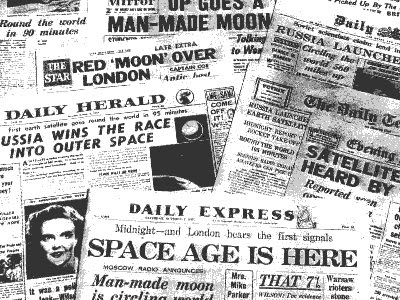
And yet it seems to me that such a momentous event has by no means produced the kind of excitement we might have expected. There was more reaction to Milwaukee winning the World Series[ii] than to the announcement of a man-made satellite running around the earth. It may be perhaps because man is getting rather blasé about his scientific achievements and takes everything in stride regardless of how impressive it may be. Or it may be perhaps because this new development is so overwhelming man is numbed by its magnitude and senses his own littleness in comparison to the power he has found himself capable of unleashing. Surely what reactions we have had to Mr. Sputnik fall short by far in measuring up to the significance of the moment.

The average man probably is conscious mostly of the destructive potential of the satellite and rather than to be worried about it tries either to shut it out of his mind altogether or says, as I heard one man say, “Mr. Sputnik is above us. Let's all have fun."

The politicians are all confused and contradict each other at every moment. The outs find it a convenient opportunity to criticize the defense policies of the ins and the ins say that what has happened will very shortly be surpassed by experiments in America still in preparation.

The scientists had yet another reaction. They are rightly quick to point out how a stupid governmental policy of harassing scientists working for the government can throw our nation back in scientific development and they now stress all the more the necessity of our youth to saturate themselves with scientific study for the sake of future survival. Dr. Elmer Hutchisson, the director of the American Institute of Physics, is quoted in the [New York] Times as having said that the nation’s youth must be taught to appreciate the importance of science or the American way of life is doomed to rapid extinction.

And yet another kind of reaction was quoted in the press as coming from such a man as Will Durrant.[iii] He admitted to not being too excited about the new satellite and said with a philosophical shrug,
I suppose it's something of importance from a national defense point of view. But to a philosopher these physical changes aren't too interesting. People will go on living about the same way as they have before. Food and sex are basic and the most important human goals, whether we live in this world or some other one.
Thus the average man, the politician, the scientist and the philosopher and what each has to contribute to the situation is possibly deserving of some thought, but there is I think a religious reaction to Mr. Sputnik that is far more significant for mankind than any of these.

Abraham Heschel,[iv] whom you have heard of on other occasions, wrote a book on the Sabbath several years ago, but it is amazing how some of his remarks in that book seem to fit the very situation we now speak of. Judaism, he says, is a religion of time aimed at the sanctification of time, and what we do with time, he suggests, is more important than what we do with space. Heschel says, 
Technical civilization is man's conquest of space…. To enhance our power in the world of space is certainly one of our tasks. The danger begins when in gaining power in the realm of space we forfeit all aspirations in the realm of time. There is a realm of time where the goal is not to have but to be, not to own but to give, not to control but to share, not to subdue but to be in accord. Life goes wrong when the control of space becomes our sole concern.

Ralph Waldo Emerson was not the mystic theologian that Professor Heschel is but in a different way he expressed somewhat the same thought also about time. When the first railroad successfully spanned the continent he was asked what he thought of it and he said, "It will certainly help man travel faster, but will it make him better." Mr. Sputnik may be more dramatic than a railroad, but for religion Mr. Sputnik, like the first railroad, merely accentuates the question of, “How is man to handle the power and the knowledge that he acquires?” Speed and distance are exhilarating and desirable but does not life indeed go wrong when the control of space becomes our sole concern?

The question is not a new one brought to our attention only in the modern world of science. The question is one that is as old as man. In the Torah portion of this week the first in the Torah[v] which speaks of the creation of the world, it is already alluded to. We read of the creation of the world and then of the creation of man. Man is then placed in the garden of Eden where life is perfect and there are no problems, but man ignores the command of God and so is driven out of the garden. To prevent his return a revolving sword of flame is placed at the entrance. The writer of the story does not, of course, use the word "utopia," but he nevertheless has written the story to explain the problems of society, the presence of pain and toil and conflict, and in his own unsophisticated way he has suggested that man has deprived himself of the pleasure of living in a utopian society because of his own disobedience of God's law. The rabbis later on, in their own reading and interpretation of this chapter, underscored this meaning. In the Midrash they speak of Adam standing by the entrance to the Garden of Eden and when he noticed a revolving sword guarding it, they say he cried out, "What will save my children from this revolving weapon of flame?" The answer came back to him, they saidthe weapon of Torah. Man's future and man salvation, they thus pointed out in a truth that remains valid, depends not on anything physical or spatial but upon his intelligent use of the weapon of moral law.

The revolving sword of flame is now a revolving satellite moving about the earth, but if we are wondering how to cope with it, the answer is the same now as it was in ancient times. Its challenge is no different than that which man has faced all through the ages. If there is a difference it is only that the challenge is more crucial and more immediate because of the greater power and speeds and distances that man now finds himself involved with, and the energies that he can loose but not necessarily control. And the answer is not in rivalries which produce competition among nations in scientific research, competition in the ability to manipulate great forces and in directing great missiles, but in broader cooperation, in the reduction of national pride, in the realization that the future of mankind depends not on the intercontinental missile or the rocket to the moon, but rather on the weapon mentioned by our rabbis, the weapon of Torah, the force of moral law.

We need not be altogether pessimistic. We are now in the midst of an international geophysical year. The scientists of the world with the blessing of their governments have joined in mutual cooperation to explore the secrets of the universe, to search out new knowledge and are pledged to share what they find. If we can achieve such cooperation in the finding of knowledge why should it not be possible to carry on similar cooperation in the application of this knowledge for the good of humanity and not its hurt? We have been banded in a United Nations where many political problems have been discussed and at least some shooting wars avoided. If only this process can continue until the habit is sufficiently fixed that there shall always be discussion and the shooting become altogether obsolete. The surface signs of cooperation however do exist and we need to exert ourselves earnestly to expand them. Standing as we do on the threshold of amazing new adventures for mankind, it seems hardly likely that anyone will run the risk of ending it all by intentionally calling down destruction.

Let us pray only that we may be spared the effect of unintentional blunders that get out of control. In next week's portion of the Torah there is another story which has bearing on our situation today. In next week's story[vi] we are told of the very first venture of mankind into space. Man united their efforts in order to build themselves a tower which would penetrate into the heavens, and they failed, and God scattered themwe are toldover the face of the earth. But why did they fail? In uniting their efforts and resources surely mankind was doing something worthwhile, something we are desperately trying to achieve today. But we are told man failed because of the motives that were involved. Man wanted to penetrate space in order to get himself a name. It was the spirit of arrogance that move them, and of rebellion against God.

Our penetration of space today is not by means of a tower, but by means of rockets and satellites, yet the same moral applies to us today. If there is arrogance involved in our achievements, then destruction will result and we shall be scattered. Above all, today we need to remain humble in our accomplishments. We must yet remember if Mr. Sputnik is above us, God is also above him and us together. Indeed, the more we venture forth into the unknown, the vaster and the more unknown the rest of the universe becomes and the more humble ought man to be. If we put our triumph over space in proper perspective, and if our achievements make us more conscious of the mystery of the universal and divine law which makes such a thing as a satellite possible and predictable, if this be what Mr. Sputnik will define, then what we do shall possibly be for the benefit of man and his ultimate glory. May it be our will and the will of God that it shall be so.


[i] Sputnik 1 was the first artificial satellite to be put into Earth's orbit. It was launched into an elliptical low Earth orbit by the Soviet Union on 4 October, 1957. The unanticipated announcement of Sputnik 1's success precipitated the Sputnik crisis in the United States and ignited the Space Race, a part of the larger Cold War. The launch ushered in new political, military, technological, and scientific developments. While the Sputnik launch was a single event, it marked the start of the Space Age.
[ii] The 1957 World Series featured the defending champions, the New York Yankees playing against the Milwaukee Braves. The Braves won the Series in seven games. Of the previous ten World Series, the Yankees had participated in eight of them and won seven. This was also the first World Series since 1948 that a team from New York did not win.
[iii] William James Durant (1885 – 1981) was a prolific American writer, historian, and philosopher. He is best known for The Story of Civilization, 11 volumes written in collaboration with his wife Ariel Durant and published between 1935 and 1975. He was earlier noted for The Story of Philosophy, written in 1926, which one observer described as "a groundbreaking work that helped to popularize philosophy."
[iv] Abraham Joshua Heschel (1907 – 1972) was a Polish-born American rabbi and one of the leading Jewish theologians and Jewish philosophers of the 20th century.
[v] Parashat Bereishit, Genesis 1-6:8
[vi] Parashat Noach, Genesis 6:9-11:32 After recounting the familiar story of Noah the weekly portion describes how the earth was repopulated through Noah's three sons. The descendants of Noah remained a single people with a single language for ten generations. They eventually returned to evil ways by uniting in an idolatrous religion that led them to build a “tower with its top in the heavens"—the so-called tower of Babel.


June 24, 2012

Jewish Peoplehood in America -- Yom Kippur, 10/5/57

The following sermon is surely a product of its times. It stems from an era that was a good deal less pluralistic than today,[i]  a time when political correctness was unheard of and sensitivities about speaking one’s mind were less prevalent. Therefore Sidney Ballon’s exposition on the distinctions of Judaism among the three dominant religions in 1950’s American society may seem chauvinistic by today’s standards. Some may find this a bit jarring. Regardless, Ballon unhesitatingly makes the case that Judaism is important, relevant and unique—qualities that it arguably maintains to this day. He extols the need, as he often did over the years, for Jews to connect to their common history, language, and homeland, and not to succumb to conformity with the prevalent society.
-->
It is possible for the essentials of our faith to be almost imperceptibly diluted in our natural desire to be like others among whom we live.

====================================================
In his book entitled Protestant, Catholic, and Jew, Will Herberg[ii] presents and analysis of the tremendous increase in religious affiliation in present day America. His thesis, which has been referred to again and again from almost every pulpit is must reading for anyone who is interested in the subject.  The major point that he makes is that America, the great melting pot for many peoples, had developed religiously speaking into a triple melting pot. We have here, in the course of time, tended to eliminate all differences and barriers that have existed among the various ethnic groups that have come to this land save one, and this one we have rather encouraged to remain. The religious difference has been preserved. Religiously, America has not served to fuse everyone into a single pattern, but has rather encouraged three different forms, Catholic, Protestant, Jewish, any one of which is considered to be normal and appropriate on the American scene. As a matter of fact, not to be identified as either Catholic, Protestant, Jew is somehow not to be fully part of the American way of life. Rightly or wrongly, there is a tendency somehow to regard all people not committed to one of the major faiths as being disloyal to American principles. Atheists, agnostics, humanists are today at a disadvantage, as we may note particularly in the numerous controversies that arise on the question of religion in the schools.

For us as Jews this has had an interesting consequence. There was a time about a generation ago when our young people, in their effort to make of themselves good Americans, often felt that they had to reject the faith of their immigrant fathers because that faith connoted for them something foreign which was not at home in the new land. But now this same urge to conform to the American scene leads in the opposite direction because today conformity to the American pattern causes acceptance of religious affiliation rather than rejection. Being American today seems to make religious identification mandatory.

Many good things have resulted from this development in addition to the increase of religious enrollment. Not least among these is the greater degree of religious tolerance and a stronger feeling of common purpose among the three great religions. But Will Herberg points out drawbacks as well. On the one hand the taint of foreignness has been eliminated from the three faiths, and this removes a formidable obstacle to their transmission and preservation, but on the other hand the Americanization of religion has meant a distinct loss of the sense of religious uniqueness and universality. Each faith, he says, as far as the masses are concerned tends to regard itself as merely an alternative form of being religious in the American way. We tend to emphasize our common ground and to suppress our distinctive characteristics. We tend to make a super-religion of Americanism with the three major religious groups as subdivisions, and this results in a distortion of the authentic character of each faith in itself. Thus, even in the expression of religious difference, there seems to be an element of conformity which takes away from each faith something of its uniqueness and peculiar meaning.

I shall not touch upon this problem as it affects the branches of the Christian faith, but let us consider it to some extent at least as it pertains to Judaism. Judaism, particularly in our Reform interpretation, agrees that there must be adjustment to locale and time, but it cannot continue in a meaningful way if its completely overpowered and overshadowed by conformist Americanism. Judaism is certainly very much at home in the American environment and rejoices in the freedom which gives opportunity for expression as never before, but it must use this freedom to preserve its uniqueness and universality and not sacrifice them in a desire to be completely like unto our neighbors.  One aspect of uniqueness in particular, that tends to suffer on the American scene and which is fundamental to our faith, is our concept of the peoplehood of Israel and its role in the world. We speak very often about the fashioning of an American Judaism, which is all to the good, but that Judaism should not be an all-American Judaism to the neglect of our historic ties and eternal values.  Politically we are citizens of America and happy that it is our good fortune to be so, but spiritually our scope is broader than America, and we are part of a people with deep roots in time and widely scattered in space. We are not an American denomination, but a branch of a worldwide spiritual community. The memories of Americanism go back to Valley Forge or Plymouth Rock, but the memories of Judaism go back to Abraham and Sinai and are shared by fellow Jews throughout the globe.

The element of peoplehood is one of the basic ingredients of Judaism. Our peoplehood constitutes one of the major differences between us and the Christian faith. The Christian fellowship is based upon a church. It is an organized association of men drawn from one people or many peoples held together by a common creed or religious discipline. History has made of Judaism, on the other hand, the religion of a single people, the Jewish people. A people is not an association of individuals. A people is a chain of generations united by a common history and a common cultural origin that can be traced to a common land. It has been rightly observed that the connection between the generations of a people is just as intimate as that between the generations of a family. The soul of a people and the soul of a family belong equally to the individual. One can resign from a church, but one cannot resign from the Jewish people.

Christianity is concerned with history only to the extent that a single episode in history is the basis of its faith. Judaism in contrast is concerned with all of history because it is a faith which emerged out of the total history of a people rather than out of the story of a single man. That episode of history which is most significant to Judaism was the covenant at Sinai. The significance of this covenant was not in the immediate moment but was the result of historical events concerning the people of Israel up to that moment and was a compact which committed a people to be the servants of God beyond the moment—not merely the generation that stood there at Sinai but also for those who are here this day—as we have just read from the Torah. The significance of Judaism today remains as the faith of a people who have chosen to be a holy people and a kingdom of priests. It is true that as Jews our religious interests are of prime importance. The people of Israel without religion is a purposeless entity, but on the other hand without the people of Israel our religion is a disembodied soul. Without a sense of peoplehood and spiritual unity with fellow Jews of past and present and even of the future, Judaism has its foundations pulled out from under and comes toppling down.

How can we keep our sense of peoplehood alive in the face of an environment which tends to make us feel self-sufficient as an American Jewish community and tends to weaken our family ties? There are several things which can help. First it is important for us to saturate ourselves with the knowledge of Jewish history. History to the Jew is as vital as the catechism to the Christian faith. Eleanor Roosevelt said the other day, on returning from Russia, that Americans needed to study more history. Only then, she said, would we understand the world better and handle our political problems more maturely. The Jew likewise needs a sense of history to understand and appreciate his faith the more. Through the understanding of an identification with the heroic story of the Jewish past we shall acquire a sense of belongingness to the Jewish people that we shall never lose.

We need secondly to cultivate as much as possible the Hebrew language, and to use it at least to some extent as a medium of prayer, if not more. It is the Hebrew language which holds the idiom of our faith. It is in Hebrew that the Bible was written and is best understood. It is the one language that we share an allegiance to with all Jews of whatever type they may be or where they are from. It is the reminder of our common heritage as Jews as no other symbol can be.

And finally we must retain our interest in the land of Israel as something special. We cannot agree that the Jewish community of Israel is just another Jewish community of no more interest or consequence to us than any other. The Jewish settlement of Israel is more than a place of refuge. Jews have found refuge in many lands through the years, not the least among them being this very land where there are more Jews than Israel probably can ever hope to hold. But Israel is the land where our faith was forged. It is the repository of our most sacred memories as a people.  It was rebuilt under the inspiration that only such a land of historic memory can fire. It is a nation in which the principle of Jewish peoplehood functions not merely in an abstract spiritual manner but in a concrete challenging form. It is a very tangible reminder of the spiritual bond that exists among the Jewish people and for these reasons Israel is something special. We are not citizens of Israel. We owe it no political loyalty as American Jews, but we are spiritually concerned with it. Jewish peoplehood is openly on display there and we should accept this land where Jewish peoplehood is understood as a reminder of kinship to Jews the world over, even as we pray, may I add, that our own Jewish community where religion is underscored will be a reminder to them of the spiritual character which they must in turn be careful not to neglect.

The Jew must always have the courage and convictions to be himself. In lands of persecution we have feared that the Jew would be physically destroyed. In lands of freedom the pressures upon our faith are more subtle, even though the opportunity to live it fully is present without restriction. It is possible for the essentials of our faith to be almost imperceptibly diluted in our natural desire to be like others among whom we live.  The Jew, however, was never known as a conformist. He was always the great protestant of history. It is precisely this characteristic which can also be our finest and best contribution to America. We do not necessarily serve the country best by casting aside our uniqueness. We may perhaps best serve by remaining our best character and by contributing not only to the religious consciousness of our land, but to its religious conscience.  There may be times when it serves a far better purpose to preserve our integrity and stand apart. Our highest loyalty is to God.
Dr. Julian Morgenstern[iii] speaking to the Hebrew Union College student body once said,
We are a people with a God appointed destiny which we cannot avert either through fear or through frenzied choice. We have been drafted by God for an eternal service which we dare not evade. We are the prophet people of history... Be this service what it may, brief or enduring... easy or exacting. Let us serve with faith, with integrity and courage... hearing constantly ringing in our ears the heartening words of our Eternal Comforter... But thou Israel, My servant, Jacob, whom I have chosen, seed of Abraham whom I do love; thou whom I have drawn from the ends of the earth and from its borders have called thee and said unto thee, My servant art thou; I have chosen thee and have not rejected thee, fear not for I am with thee.


[i] The U.S. Census Bureau no longer surveys for religion. However, according to the Current Population Survey of March 1957, a Bureau-directed monthly survey of 35,000 households, Americans of 14 years and above stated their religion as following:
  •  White Protestant 57.4%
  •  Black Protestant 8.8 %
  •  Catholic 25.7 %
  •  Jewish 3.4 %
  •  Other religion/not reported 2.2 %
  •  No religion 2.7%
  •  Total 100%
The US population was 170 million in early 1957 and now is close to 313 million. During this period, the American religious landscape has also changed significantly in four ways: 1) the adherents of religions other than Christianity are increasing every year; 2) the number of mixed-religion households is on rise (due to inter-faith marriages); 3) among religions, the composition of various denominations or sub-groups is changing and they are also becoming more important due to their socio-political activities; and 4) the number of Americans unaffiliated with religion is also growing.

A Question on Religion in the US Census, Zahid Bukhari, Project Director of American Muslim Studies Program at Georgetown University, http://acmcu.georgetown.edu/135392.html

[ii] Will Herberg (1901–1977) was an American Jewish writer, intellectual and scholar. He was known as a social philosopher and sociologist of religion, as well as a Jewish theologian.
[iii] Julian Morgenstern, Ph.D. (1881-1976) rabbi, instructor in Bible and Semitic languages, the first native-born American and alumnus of Hebrew Union College to become its president.

June 9, 2012

A Liberal Faith -- 9/26/55


This is an important essay. You might say it’s a matter of life and death. It lays out, at least in part, a case for why Jewish survival is so necessary. Sidney Ballon felt that while many of the world’s religions share common tenets, often in fact derived from Judaism, the unique message that Judaism provides to the world is too precious to lose. He found this message compelling enough to deliver it, almost verbatim, on Yom Kippur morning in three successive pulpits. First offered in Columbia, South Carolina in 1947, then the following year in Lexington, Kentucky, and finally in West Hempstead, New York in 1955, it describes three characteristics—theological, social, and psychological—that mark Judaism’s particular wisdom.
…Judaism is not just another religion that we have become associated with by the accident of birth, but it is rather a philosophy of life and a faith which we must share out of full conviction.

====================================================


As Jews all of us are proud that we are the members of a people who has given religion to the western world. Whatever our state of knowledge may be with regard to the finer points of our faith, all of us do, at least, know that Judaism first proclaimed the doctrine of monotheism. Judaism first interpreted morality as a divine commandment t man. Judaism is the mother of the two other great monotheistic faiths, Christianity and Mohammedanism. We have, indeed, fulfilled the prophetic ambition to be “a light unto the nations,[i]” and the nations readily recognize the Jewish roots of their religious faith.

Because of these achievements of the past, the thought may perhaps arise that Judaism has fulfilled its mission, that there is no religious work left to do that cannot be done equally as well by the faiths that it has already fostered. Since so many people accept monotheism and since we all speak in terms of “Love thy Neighbor[ii],” there is perhaps no longer any specifically Jewish task to be concerned with and no longer any important basic religious difference between Judaism and the other major religions. What differences that exist are surface differences of approach. Ultimately we all arrive at the same goal.


Many of us, accordingly, even those of us who are thoroughly happy in our Judaism and would never make a conscious effort to destroy it, may nevertheless, sometimes feel that if it so happened that Judaism gradually and peacefully did disappear the world would suffer no great religious loss, because its fundamental teachings have been passed on to the future through other religious groups.


The differences that remain, however, between Judaism and other groups may not be overlooked so glibly. There are religious values in Judaism which the world is still sorely in need of, particularly in these critical times, and we as Jews would do well to be aware of them and to proclaim them. Some Jewish leaders even speak in terms of a missionary effort to reach other people who may be spiritually in sympathy with us, and we all ought to have a genuine conviction of the importance of Judaism today in offering a solution, perhaps, to some of the world’s problems and in serving as a liberal faith for men to live by.


The distinctive characteristics of Judaism were once described by Rabbi Joshua Liebman[iii], of blessed memory, as falling into three categories. He said that we might sum up the virtues of the Jewish approach to life in terms of its remarkable theological wisdom, its remarkable social insight, and its remarkable psychological penetration, and I should like to touch briefly on each of these this morning.


The theological wisdom of Judaism may best be seen in its lack of dogmatism. Judaism confesses honestly that finite man cannot know all that there is to know about the infinite God. It recognizes the limitations of human knowledge and permits man to use his reason to continue the search after truth and to become ever more enlightened. The Bible was always an authoritative book in Judaism but even within the Bible there was recognition of the process of growth in religious thinking and changing conceptions of God. Thus Moses is reported to have had a different understanding of God than the Patriarchs. We read in Exodus 6, for example, God spoke unto Moses and said unto him, I am the Lord, and I appeared unto Abraham, unto Isaac, and unto Jacob as El Shaddai, but my name Adonoy I made me not known unto them. Thus it is reported that a new facet of divinity was revealed to Moses. Each prophet also viewed God from his own perspective, and to Amos He was a god of Justice, to Hosea, a God of Love and to Isaiah of righteousness and compassion. In post Biblical days the rabbis of the Talmud[iv] reinterpreted the Bible in their own manner to the extent that it was said that Moses once came down from heaven and listened to Rabbi Akiba[v] teach in the school and he did not even recognize his own Torah. And after the days of the Talmud came the teaching of the of the religious philosophers and the mystics and today the modernists, all of whom fit into the framework of Judaism without the sectarian fragmentation that characterizes other religious groups. Even in its most rigid form Judaism allowed for variations in interpretation; and tradition, and reason both played a significant role in its development. This flexibility in Judaism made unnecessary bitter conflicts between science and religion such as “Inherit the Wind[vi]” now reminds us of on Broadway, and Judaism is able to take the findings of science and to use them rather than quarrel with them.  


The emphasis in Judaism has been not on abstract dogma, but rather upon man, and his way of life and his conscience. Judaism has been a faith in which the emphasis has been not upon creed, but upon deed. Not what man believed came first, but what man did. We read from the Torah this very morning that,  “The word is nigh unto thee in thy mouth and in thy heart, that thou mayest do it.[vii]”  The doing was all-important and the believing was secondary. And one ancient rabbi even dared picture God as saying, Would that ye would forsake me, if only you would keep my commandments. And, indeed, how much better off this world would have been if through the centuries there had been a greater concern with Godly conduct rather than the creeds that men have professed!


This flexibility in dogma contributed to a second virtue in Judaism, its social insight. The social insight of Judaism is perhaps best reflected in its concept of salvation. Because Judaism was basically tolerant of variation in religious belief, it did not proclaim salvation as the exclusive property of one particular creed. A particular belief did not guarantee salvation of the soul nor did the accident of birth and adherence to a different religious group deny it. Judaism proclaimed rather that the pious of all nations have a share in the world to come[viii]. There were, indeed, special demands upon the Jew but righteous living brought its reward to Jew and non-Jew alike.


The Jewish understanding of salvation is significant for another reason also. Salvation in Judaism is not a self-centered concept. Many other groups teach their followers a concern for their own individual soul in the afterlife. In Judaism salvation has a social emphasis. It is something that concerns not merely the individual alone but humanity as a whole. And it concerns not so much life after death, as man’s victory in this life over human defects, over sinfulness, ignorance, selfishness and all human failings that make for an imperfect society. And it is, furthermore, not something that we sit back and wait for. Salvation comes from God, but it must be achieved also through the effort of man, who must pitch in as copartner with God in wiping out the obstacles which stand in the way of a better humanity and a better world. And it is thus not a “pie in the sky” type of religion.

The social insight of Judaism is also reflected in what Rabbi Leo Baeck[ix] called its “ethical optimism.” Judaism recognizes that there is evil and suffering in the world, but it is neither indifferent to it nor resigned to it. It faces the world with a commandment from God to change it, and with confidence that man is capable of realizing in himself the good which he sees in God. Man can shape his life for good and it is his religious duty to do so. One might have expected Judaism, because of its bitter experience in history, to have been among the world’s greatest pessimists and to have lost faith in the possibility of redeeming mankind, but Judaism did not yield to pessimism regardless of circumstances. It maintained its faith in man’s essential goodness and in the ultimate triumph of this goodness. It continued to look forward to a Messianic age when such evil would be overcome and it continued to look upon its task in the world as one of sanctifying God by overcoming evil and realizing good. The vision of the end of days was the motivating force in Jewish history and a factor making for survival. This way of thinking is in striking contrast to the pessimistic view that man is a hopeless sinner entangled in original sin for which he was not even responsible, that man is not capable of achieving salvation for himself but is dependent upon the grace of God which he may only hope for but cannot be sure of, because it is arbitrarily bestowed at God’s will, that man stands alone in a hostile world, trapped by the problems of his existence, and powerless to do anything about it. This is not only the thinking of ancient thinkers unfortunately, but is the trend among many noted modern religious thinkers as well.

The accomplishments of a society, just as well as those of an individual may be determined to a great extent by the attitude with which it faces its problems, and if we approach our lot with pessimism then we handicap ourselves at the outset in dealing with the challenge that confronts us. If we are to survive the crisis of the atomic age there is a crying need for the tolerance, the concern for our fellowman and the confidence that emanates from Judaism.

And finally the psychological penetration of Judaism is evident from a comparison of Judaism with the patterns that psychiatrists today say makes for mental health among individuals and groups. Judaism seems instinctively to have inclined towards these patterns even in the days before there was any inkling of the science of psychiatry. Psychiatric subjects are complex, and non-experts should hesitate to discuss them, but this relationship of religion to psychiatry was a favorite field of study of Rabbi Liebman whom I previously mentioned and I bring you briefly some of his thoughts on this subject.

Judaism, he points out, has shown psychological wisdom by avoiding doctrines which might make for a sense of guilt or a sense of frustration in man. Judaism, for example, has never espoused as a great virtue the doctrines of “turning the other cheek[x]” or “loving thine enemy[xi].” In Judaism there has always been room for anger as well as love. In Judaism there has been room for righteous indignation as well as profound compassion. This has not been a defect in Judaism as some may be tempted to say. The society at large in which we live theoretically calls for a perfect love in men’s hearts. It has asked men to turn the other cheek and love their enemies and a paradox has resulted. Our own generation has seen not love, but concentration camps and crematories and war. Rabbi Liebman attributes this to the doctrine of unattainable perfectionism, and describes the process as follows. If you tell people that you must achieve perfect, unblemished love, man says to himself, “Superb ideal. I wish I could reach it.” But he cannot reach it because he is merely human with human emotions and imperfections, and therefore, because he cannot reach it he becomes obsessed with guilt in one form or another. The guilt becomes hate. Hate is repressed and then leads to an explosion such as the violence of a decade ago. A society which does not allow any room in the world for the passions and instincts of man begets a split personality and the anger which has not been given a creative outlet breaks out with the savagery that has plagued our civilization. Judaism allows for outrage, for indignation. And righteous indignation is something the world needs more of. Turning the other cheek, after all, is to countenance an injustice.

Nor does Judaism try to repress the normal and natural emotions of man. Judaism does not favor the ascetic. It is man’s obligation to enjoy life, and religious function to help him do it properly. An ancient sage said that “he who sees a legitimate pleasure, and does not avail himself thereof is an ingrate against God who made it possible.” It does not care for frustrated personalities who have withdrawn themselves from life’s battles. Judaism never saw any conflicts between the flesh and spirit. It avoided overemphasizing either but approved of both in proper balance. Man was neither to thwart his body or give in to it, but rather to sanctify it. Marriage was never considered a concession to the flesh, but a sanctification, and love became a high adventure of the human spirit.

All this has not been an outline of Judaism. It has been only brief mention of significant highlights which give you perhaps some indication of the trend of Jewish thinking and which I hope demonstrate the continuing importance of the message of Judaism in the world today. We have only skimmed the surface but I hope it has been sufficient to convince us that Judaism is not just another religion that we have become associated with by accident of birth, but it is rather a philosophy of life and a faith which we must share out of full conviction. In our Torah reading this morning we read, “I call heaven and earth to witness against you this day that I have set before you life and death, the blessing and the curse; therefore choose life that thou mayest live.[xii]” Judaism is life. Let us choose it in pride and joy, and proclaim it as a saving message to the world.   


[i] Light Unto the Nations (Hebrew: אור לגויים, pronounced as "Or LaGoyim"); is a term originated from the prophet Isaiah which may express the universal designation of the Jewish People as a mentor for spiritual and moral guidance for the entire world. "I the Lord have called unto you in righteousness, and have taken hold of your hand, and submitted you as the people's covenant, as a light unto the nations" (Isaiah, 42:6)
[ii] Leviticus 19:18 “…thou shalt love thy neighbour as thyself: I am the Lord.” Also quoted in the New Testament, Mark 12:31, “'Love your neighbor as yourself.' There is no commandment greater than these.”
[iii] Joshua Loth Liebman (1907-1948) was an American rabbi and best-selling author, best known for the book Peace of Mind, issued in 1946, which sought to reconcile religion and psychiatry, and spent more than a year at #1 on the New York Times Best Seller list.
[iv] The Talmud is a central text of mainstream Judaism. It takes the form of a record of rabbinic discussions pertaining to Jewish law, ethics, philosophy, customs and history.
[v] Akiva ben Joseph (ca.40–ca.137 CE) simply known as Rabbi Akiva was a great authority in the matter of Jewish tradition, and one of the most central and essential contributors to the Mishnah, the first major written redaction of the Jewish oral traditions.
[vi] Inherit the Wind, a play by Jerome Lawrence and Robert Edwin Lee which debuted in 1955, is a story that fictionalizes the 1925 Scopes "Monkey" Trial which resulted in John T. Scopes' conviction for teaching Charles Darwin's theory of evolution to a high school science class, contrary to a Tennessee state law that prohibited the teaching of evolution.
[vii] Deuteronomy 30:14
[viii] Sanhedrin 105a
[ix] Leo Baeck (1873-1956) was a 20th century German Rabbi, scholar, and a leader of Progressive Judaism. “There is only one complete and flawless optimism, and that is ethical optimism.”— from his best-known work, The Essence of Judaism, 1905.
[x] Turning the other cheek is a phrase in Christian doctrine that refers to responding to an aggressor without violence. The phrase originates from the Sermon on the Mount in the New Testament.
[xi] In the Sermon on the Plain in the Gospel of Luke, Jesus says: “But I say unto you which hear, love your enemies, do good to them which hate you.”
[xii] Deuteronomy 30:19

May 25, 2012

The Wisdom of the Heart -- 9/20/61

Happy 100th Birthday Rabbi Sidney Ballon!!! Would that he were here today in good health to hear these words. Would that we would have had an additional twenty-six years to hear his words. Taken much too early in his life, and certainly in the lives of those of us who loved him. It has been a source of some consolation to drink in the words he left on thousands of aging pieces of paper, and to have the privilege of sharing them with other avid readers. Even more so, having them share their memories of him with us.

For this special day, the one-hundredth anniversary of his birth, I selected a Yom Kippur sermon from 1961. Sidney Ballon was a person of great intellect, logic, and discipline. These qualities were present even when he argued with passion for Jewish values, Jewish causes, and for the very survival of the Jewish people. Like certain rocks to which he refers in this sermon, that appear ordinary until viewed in ultraviolet light and then glow with color, this sermon reveals, perhaps more clearly than any other, not only his intelligence, but his spirit. He is seen in a different light herein. Even the title, The Wisdom of the Heart, seems to reveal a side of Rabbi Ballon that may have been ever present, but less visible at times—the sweetness of his spirituality.
May we find lasting inspiration in the experience of this day. May its recollection be a support to us through the year to come, and may we so live as to reflect a constant awareness of the reality of God among us.

Throughout the years Rabbi Ballon judiciously “recycled” sermons that he had delivered at previous congregations. Upon arriving at his semi-retirement position at Temple Beth Tefilloh in Brunswick, Georgia in 1974, he had his entire career’s archives at his disposal. Interestingly, when he dipped into his file of High Holy Day sermons this was the one he selected to deliver at his first and what became his only Yom Kippur there. Perhaps it was for the clarity, simplicity, and the power of the message: listen to your heart, and believe!

====================================================

There is no holy day on our religious calendar that is more emotionally charged than the Day of Atonement which we now observe. It begins with the awesome tones of the Kol Nidre[i] chant. It continues through a day of fasting, of solemn prayer and meditation on life and death. It ends in a spirit of deep humility with the concluding service of Neilah[ii]. And from beginning to end there is a feeling of being in the presence of what a noted religious philosopher has called the mysterium tremendum, a term which practically explains itself, the great mystery, the indescribable and unknowable power that permeates the universe. It was, indeed, after visiting a Yom Kippur service in a North African synagogue that Rudolf Otto[iii] conceived of the idea of the mysterium tremendum and wrote his book in which he called it the central factor of all religion. There is a touch of mystery inherent in Yom Kippur. Everyone present in the synagogue, I venture to say, senses it to some extent at least, and it is even possible to have one’s entire life changed by it.

One man whose life was changed by his Yom Kippur experience was Franz Rosenzweig[iv]. I wonder how many of you have heard of him. Franz Rosenzweig was a young German Jew with a brilliant mind. He possessed a deep knowledge of philosophy, but knew very little about Judaism. One day he came to the conclusion that he wanted to become Christian, and he was encouraged in this by several friends. But he decided to go about his in a strange way. He said he did not want to enter Christianity as a pagan, but rather like its founders as a Jew. He, therefore decided to subject himself to a Jewish experience in preparation for his becoming a Christian, and so on the High Holy Days of 1913 he attended services in a synagogue. His attendance on Yom Kippur was thus supposed to be a sort of leave-taking of this people, after which he was to be converted. He was truly converted on that day. It was however, a total conversion to Judaism. When the Neilah service had ended and the final cry of Shema Yisroel[v] was pronounced, Rosenzweig was wholeheartedly a part of the congregation, and he joined with them in this declaration of faith. He had been recaptured by the magnetic mood of the day, and sometime later in a lecture he said,
Anyone who has ever celebrated Yom Kippur knows that it is something more than a mere personal exaltation or the symbolic recognition of a reality such as the Jewish people—it is a testimony to the reality of God which cannot be controverted.
Rosenzweig in the years subsequent to this significant visit to Yom Kippur services became one of the most creative Jewish thinkers of the century, a Jew whose faith remained firm and unshakable, even through long suffering from the effects of a crippling paralysis, which caused his death in his early forties.

Another man whose life was profoundly changed by a Yom Kippur service was not Jewish at all but rather a young French Catholic who had been planning on entering the priesthood. His name was Aime Palliere,[vi] and in his autobiography entitled, The Unknown Sanctuary he tells us of a strange incident which occurred when he was seventeen, which kept him from fulfilling his plan. While he was on vacation in 1902, he just happened to be passing by a synagogue with a friend. His friend had heard that the Jews were observing a great festival that day and suggested they go into the synagogue. Palliere had been raised in a very religious atmosphere and a pious Catholic would not ordinarily go into a synagogue, but he, nevertheless, yielded to the suggestion. It was the time of the Neilah service, and that unique moment changed his life. Palliere tells us that he cannot fully explain what happened to him. He calls it an unfathomable enigma. Actually there was no sudden flash of transformation, but the effect of that moment influenced his thinking and feeling to such an extent that his whole life took a different turn. Palliere had no background whatsoever in Jewish matters. He could not understand the service nor interpret what was going on. It was for the moment a confused experience for him, but the electricity of the occasion communicated itself to him. What he sensed particularly, he says was the mystery of Israel as reflected in two characteristics that were revealed to him. One, he says, is the form of collective priesthood[vii] which is basic to Judaism, that is, the equality of all Jews. All Jews are priests. And two, the spirit of expectancy, the faith in the future, which is the special seal of Judaism. Judaism was an ancient religion, but he noted that it, nevertheless, did not look to the past, but in a living and dynamic manner still hoped for achievement in the future. On that day, he said, he first beheld the people to whom the nations had been ungrateful, who had survived despite all things. While the other great peoples of antiquity had disappeared from the face of the earth, Israel had been preserved for providential ends. Aime Palliere did not formally convert to Judaism, but his visit to the synagogue on Yom Kippur, the insight that he gained at that Neilah service, moved him to study Judaism thoroughly, to love it and to live it to the same extent as if he had, indeed, been fully a Jew.

We, who sit here tonight in this sanctuary, will probably not find the direction of our life so dramatically changed by this Yom Kippur service as were the lives of Rosenzweig and Palliere but even if we are not like them in that respect, I believe that we are like them in that we, too, on Yom Kippur sense something of the mystery of God and Israel. For us also Yom Kippur is a moment to truth when our emotions overcome our sophistication, when our enslavement to cold reason is temporarily suspended, when there is a surge of faith within us and we feel that somehow we have glimpsed something holy and meaningful, have drawn near to the sacred and divine.

And assuming all this to be true, I present you with a simple plea this evening. Believe in yourself at this moment, and do not later repudiate what you now feel. Do not think that this reaction to Yom Kippur is mere sentimentality or the result of nostalgia. Do not be ashamed of it or embarrassed by it. Do not reproach yourself for having been touched by the seemingly irrational, but rather accept these intuitions of the heart as a meaningful experience. Trust these intuitions of the heart as a clue to ultimate truth and allow the memory of them to sustain you in later moments when you may possibly be susceptible to doubt and questioning.
In this scientific age so many of us tend to disparage our religious emotions and to believe in only what we can prove by the logic of the intellect or the testimony of the five senses. But man’s intellect and senses do not necessarily tell us all that there is to know about reality, and the admonition of the poet[viii] is in order,
O WORLD, thou choosest not the better part!
It is not wisdom to be only wise,
And on the inward vision close the eyes,
But it is wisdom to believe the heart.
In this scientific age we are so enamored of the achievements of man’s mind and the truly magnificent progress that has been made in adding to our knowledge of physical things, that even in religious matters intellectual proof is expected, and we ask, “How do you know, can you prove it?” But religious problems cannot be handled in quite the same way as the problems of the physical world. We cannot depend altogether on rational proof. We cannot prove in a scientific sense the answers to the religious questions of God and Immortality and Human Destiny and such. We can only, even as we do on Yom Kippur, stand in awe before the mysteries of life and place some trust in the revelations of the heart. This is not to say that reason is to be excluded from our religious searching. Certainly in Judaism reason is never repudiated, but reason must be supplemented and cannot by itself help us find our way.

Many are the mysteries which reason cannot now and never will be able to unravel alone. There is the mystery of why there is anything in existence at all. There is the mystery of our own individual, unique, never-to-be duplicated self. There is the mystery of what is life, what really is man who is able to conceive of beauty, goodness, and truth. There is the mystery of the universe, its order and regularity, its infinite space and there is indeed, the not insignificant mystery sensed by Palliere in the synagogue, that of the people of Israel who have lived through centuries of hardship and frustration, who have been able to recover from the cruelest tragedy imaginable and go on new achievements. Einstein once said that to feel the mystery of all existence is the fairest experience of man and “he who knows it not and can no longer wonder can no longer feel amazement is as good as dead.”[ix] But our intellect will not answer the questions this experience of mystery poses. The answers—or more accurately some small insight into the answers—can come only from the revelations of the heart. It comes as Abraham Heschel says, only in the feeling that all existence is embraced by some spiritual presence we call God, although we cannot always describe it or define it.

Prof. Henry Overstreet has told the story of how he once stopped at a collector’s shop in Tucson, Arizona where many kinds of minerals and stones were on display.  In the course of his visit he was taken into a small room where rocks were laid out on shelves. They were quite ordinary looking rocks. Had he seen them elsewhere he probably would not have given them a second glance. But the man in the shop closed the door so the room was in total darkness and then turned on an ultraviolet lamp. Instantly these ordinary rocks become transformed and brilliant colors of indescribable beauty were seen upon them. It made him realize what hidden realities there are all around us not perceptible to our ordinary vision, but which need some special power to make them evident.

This day of Yom Kippur releases such a special power which enables us also to sense the presence of hidden realities which are not always evident to our senses, and just as the colors remained inherent in the rock when the ultraviolet was dimmed, so what we feel here tonight remains real and true though our emotions may wane when we turn again to our daily routine. May we find lasting inspiration in the experience of this day. May its recollection be a support to us through the year to come, and may we so live as to reflect a constant awareness of the reality of God among us.


[i] Kol Nidre, (lit. all vows) is an Aramaic declaration recited in the synagogue before the beginning of the evening service on every Yom Kippur, the Day of Atonement. Though not a prayer, this dry legal formula and its ceremonial accompaniment have been charged with emotional undertones since the medieval period, creating a dramatic introduction to Yom Kippur.
[ii] Neilah, (lit. locking, as in locking the gates of prayer) the concluding service on Yom Kippur is the time when final prayers of repentance are recited.
[iii] Rudolf Otto (1869–1937) was an eminent German Lutheran theologian and scholar of comparative religion.
[iv] Franz Rosenzweig (1886–1929) was an influential German Jewish theologian and philosopher.
[v] Shema Yisroel (or Sh'ma Yisrael) ("Hear, [O] Israel") are the first two words a verse of Torah that encapsulates the monotheistic essence of Judaism: "Hear, O Israel: the Lord is our God, the Lord is one," found in Deuteronomy 6:4.
[vi] Aime Palliere (1868-1949) was a French Catholic, who became a Noahide, a non-converting adherent to Judaism.
[vii] Exodus 19:6, “and ye shall be unto Me a kingdom of priests, and a holy nation. These are the words which thou shalt speak unto the children of Israel.”
[viii] O World, Thou Choosest Not by George Santayana  (b. 1863)
O WORLD, thou choosest not the better part!
It is not wisdom to be only wise,
And on the inward vision close the eyes,
But it is wisdom to believe the heart.
Columbus found a world, and had no chart,
Save one that faith deciphered in the skies;
To trust the soul’s invincible surmise           
Was all his science and his only art.
Our knowledge is a torch of smoky pine
That lights the pathway but one step ahead
Across a void of mystery and dread.
Bid, then, the tender light of faith to shine
By which alone the mortal heart is led
Unto the thinking of the thought divine.
[ix] Albert Einstein, The World as I See It, Secaucus, New Jersey: The Citadel Press, 1999, p. 5. “The fairest thing we can experience is the mysterious. It is the fundamental emotion which stands at the cradle of true art and true science. He who knows it not and can no longer wonder, no longer feel amazement, is as good as dead, a snuffed-out candle. It was the experience of mystery — even if mixed with fear — that engendered religion. A knowledge of the existence of something we cannot penetrate, of the manifestations of the profoundest reason and the most radiant beauty, which are only accessible to our reason in their most elementary forms-it is this knowledge and this emotion that constitute the truly religious attitude; in this sense, and in this alone, I am a deeply religious man. I cannot conceive of a God who rewards and punishes his creatures, or has a will of the type of which we are conscious in ourselves. An individual who should survive his physical death is also beyond my comprehension, nor do I wish it otherwise; such notions are for the fears or absurd egoism of feeble souls. Enough for me the mystery of the eternity of life, and the inkling of the marvelous structure of reality, together with the single-hearted endeavor to comprehend a portion, be it never so tiny, of the reason that manifests itself in nature.”